Designer & Engineer • Academic project
Research Atlas: Designing a visual search tool for interdisciplinary research
Built a Next.js web app that replaces scattershot search with an interactive map revealing key topics, pivotal works, and links between them for interdisciplinary research.
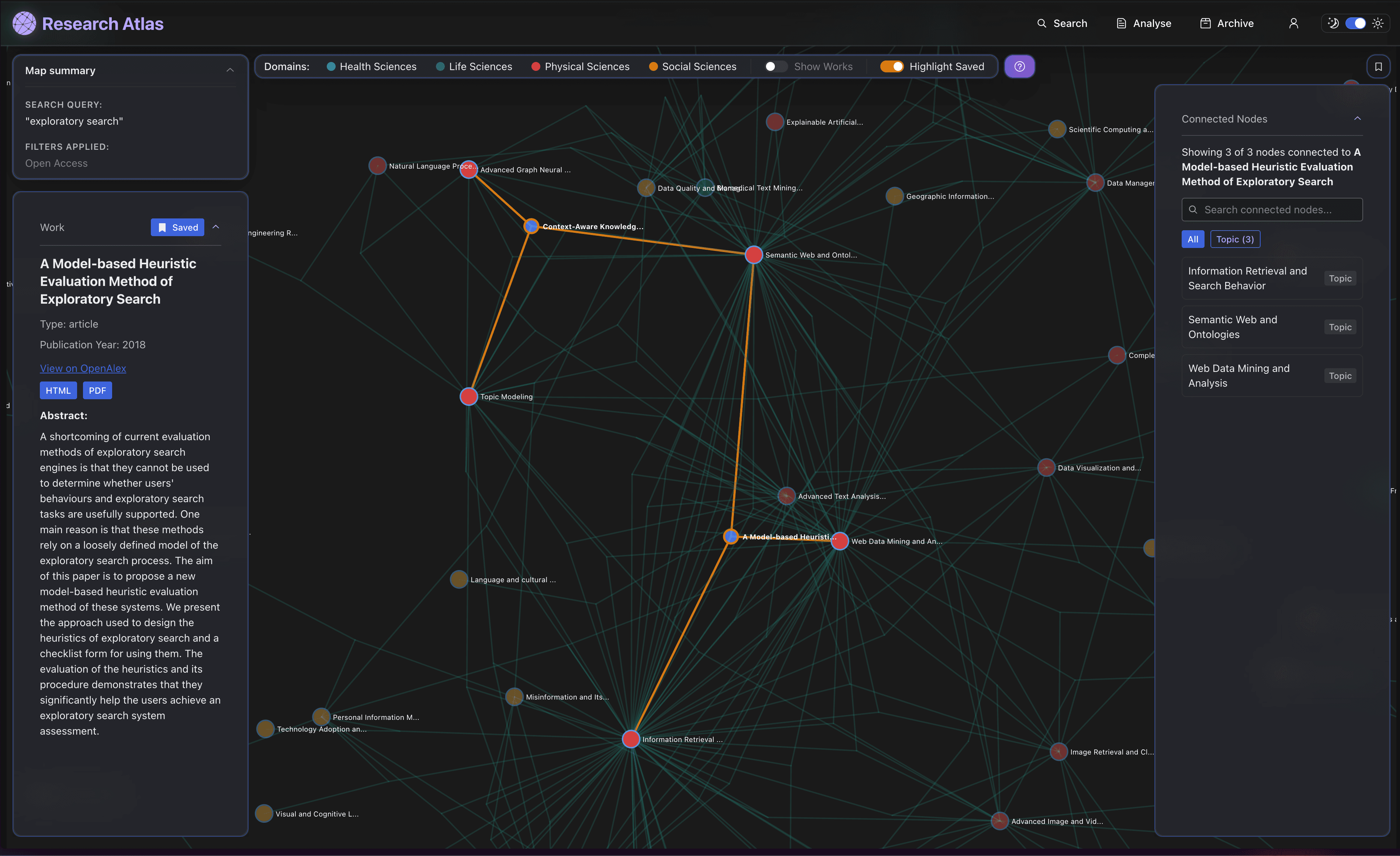
Summary
Research Atlas began as my Master's thesis at the London Interdisciplinary School. It is a web application that helps users enter unfamiliar academic domains by revealing key topics, pivotal works, and their relationships.
Problem
Interdisciplinary students and researchers frequently have to enter new research domains with limited time for orientation and context building. To do so, they use information-seeking frameworks and tools for exploratory searc, but often encounter the following pain points:
- Information overload and high cognitive load.
- Disciplinary silos and Belkin’s anomalous state of knowledge.
- Opaque and serendipity-dependant search that hides provenance reducing trust and transfer.
Hypothesis
We can make navigating unfamiliar research domains more intuitive and effective for interdisciplinary students and researcher by addressing the following Jobs to Be Done (JBTD):
- Given that existing methods are reliant on serendipity, I want to reliably encounter key concepts, so I can gain understanding more quickly.
- Given that scaffolding reduces cognitive load and berrypicking helps to create emergent schema, I want to learn how concepts are related, so I can grasp the domain’s structure and schema.
- Given that information is hard to trust when prioritised in an an opaque way, I want information to be provided in a transparent way, so I can trust it.
- Given that academic articles are often siloed, I want to traverse silos, so I don’t miss important articles.
- Given that researching an unfamiliar domain is a persistent activity, I want to save my progress, so I can search persistently.
- Given that visualisations reduce cognitive load, I want information visualised for me, so I can process more of it.
Solution
A web app that addresses the Jobs to Be Done (JBTD) detailed above by combining progressive disclosure, visual externalisation, and transparency. Research Atlas, a Next.js app hosted on Vercel, helps researchers form mental models faster, traverse silos, and retain context. It retrieves works from OpenAlex, stores selected fields in Neo4j Aura, renders topic‑work graphs with D3, and uses Supabase for Postgres, auth, and archives. There are 3 core user flows:
- Search — Enter a term; retrieve ~200 works; map topics and relationships to expose the domain’s schema.
- Analysis — Paste a paper’s title and abstract; extract topics and retrieve related works per topic.
- Archive — Save works, topics, and whole maps for later return.
Outcomes
During beta testing, Research Atlas was measured both quantitatively and qualitative:
- Quantitative: A 'Great' Real Experience Score of 96/100 (Vercel Speed Insights) across 115 visits over 30 days. Real Experience Score is a weighted average of the following metrics: First Contentful Paint, Largest Contentful Paint, Interaction to Next Paint, Cumulative Layout Shift, First Input Delay, and Time to First Byte
- Qualitative: Thematic analysis of structured user feedback confirmed that Research Atlas helped users to find research areas connected to their topic of interest that they would not have found otherwise.